

Roller Shades for Commercial Windows | Louisville CO
By Bumble Bee Blinds of Boulder
Roller shades are one of the most versatile and widely used window treatments in commercial settings — and for good reason. They operate cleanly, install in almost any commercial window configuration, and come in a range of fabrics that can address virtually any light control, privacy, or heat management challenge a business faces. But not all roller shades are the same, and the fabric choice is the decision that matters most.
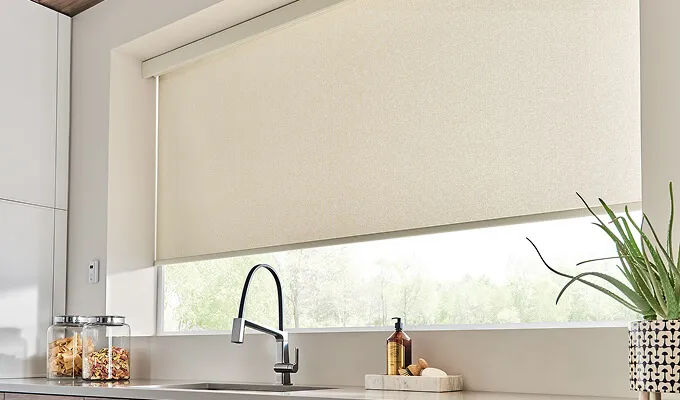
This video features a blackout roller shade installation completed by Bumble Bee Blinds of Boulder for a commercial space in Louisville, Colorado. Blackout was the right call for this particular project — but it isn’t always the right call. Here’s how to think through the decision for your own space.
Blackout Roller Shades: Maximum Light Control
Blackout roller shades use a tightly woven or coated fabric that blocks all light transmission when the shade is fully lowered. No light passes through the fabric itself, though some light may enter around the edges depending on how the shade is mounted.
Blackout shades are the right choice when a space needs to go fully dark on demand — conference rooms used for presentations or video calls, training rooms, media rooms, healthcare spaces where patient privacy or sleep is a priority, and any space that hosts events or programming requiring complete light control. They are also effective for extreme heat reduction on heavily sun-exposed windows, since blocking all light transmission also blocks solar heat gain.
The trade-off is that blackout shades offer an all-or-nothing proposition. When they’re down, the space is dark. When they’re up, the window is fully open. For spaces that need a middle ground — filtered light without full exposure — blackout isn’t the right fabric.
Light Filtering Roller Shades: Comfort Without Darkness
Light filtering roller shades allow diffused natural light to pass through the fabric while reducing glare and softening direct sun. The space stays bright and connected to the outdoors, but harsh light is eliminated and some degree of privacy is provided during daytime hours.
Light filtering is the most commonly specified fabric for standard commercial office environments. Employees benefit from natural light — it affects mood, energy, and focus — and light filtering shades deliver that benefit while making computer screens readable and reducing the thermal discomfort of direct sun. Conference rooms that don’t require full blackout, open plan offices, reception areas, and retail spaces are all strong candidates for light filtering roller shades.
The degree of light filtering varies by fabric opacity, which is typically expressed as a percentage. A denser fabric filters more light; a more open weave lets more through. Your design consultant will walk through fabric samples in your actual space before recommending a specific option.
Solar Roller Shades: Visibility With Protection
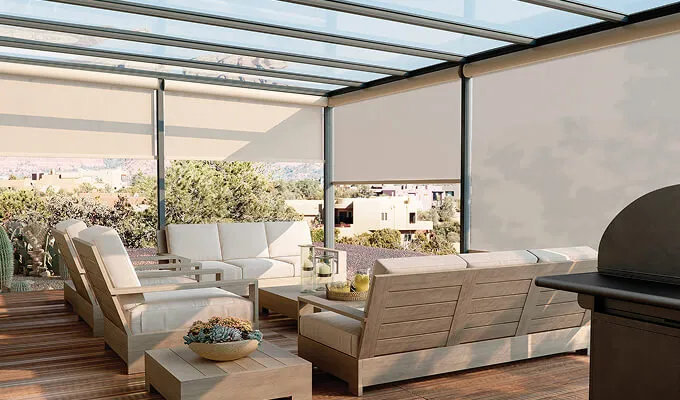
Solar shades are a specialized category of light filtering shade engineered specifically for solar heat and UV rejection while preserving outward visibility. The fabric is woven to block UV rays and reduce heat gain without making the interior feel closed off or dim.
Solar shades are the right choice when a business wants to protect furnishings, flooring, and merchandise from UV damage, manage heat gain on south- or west-facing windows, and maintain visibility to the outside — for storefront presence, views, or simply the psychological benefit of visual connection to the outdoors. They are widely used in retail, hospitality, and any commercial space where the view matters as much as the sun control.
The openness factor of a solar fabric — typically ranging from 1% to 14% — determines how much of the view is preserved versus how much solar protection is achieved. A 1% openness factor provides maximum solar protection with minimal view-through; a 10% or 14% openness factor preserves more of the view at the cost of some protection. Bumble Bee Blinds carries solar fabrics across this full range and can match the right openness factor to your specific orientation and goals.
Key Considerations When Choosing Commercial Roller Shades in Louisville
Louisville’s commercial corridor spans a range of building types and orientations — from the US 36 frontage to McCaslin Boulevard to the older downtown blocks — and sun exposure varies significantly depending on which direction your windows face and what time of day is most critical for your operation. Here are the questions worth working through before selecting a fabric:
What direction do your primary windows face, and when is sun exposure most problematic? South and west-facing windows typically need more aggressive solar management than north or east-facing windows.
Does your space need to go fully dark at any point, or is managed light the goal? If full blackout is ever required, specify blackout even if it’s only needed occasionally.
Are there views worth preserving? If your windows overlook something worth seeing — Louisville’s open space corridor, a courtyard, or even just the street activity that makes a retail space feel alive — solar shades preserve that connection in a way blackout and many light filtering fabrics do not.
What is the primary use of the space, and who occupies it? Employee-facing spaces benefit from natural light. Client-facing spaces may prioritize privacy. Healthcare and senior living spaces often have specific requirements around both.
Frequently Asked Questions About Commercial Roller Shades in Louisville CO
What is the most popular roller shade fabric for commercial offices in Louisville? Light filtering is the most commonly specified fabric for standard office environments. It keeps the space bright, reduces glare on screens, and provides daytime privacy without making the interior feel enclosed. Blackout is added in conference rooms or spaces that host presentations.
Can roller shades be motorized in a commercial setting? Yes, and motorization is increasingly common in commercial installations. Motors can be operated by remote, wall switch, app, or integrated into a building automation system. For large windows or high installations where manual operation is difficult, motorization is often the practical choice regardless of budget.
How long do commercial roller shades last? With quality fabric and hardware, commercial roller shades typically last many years in high-use environments. The fabric itself is generally more durable than residential-grade products. Regular cleaning and occasional hardware inspection are the primary maintenance requirements.
Do roller shades help with energy costs in a commercial building? Yes, particularly solar and blackout fabrics on south- and west-facing windows. Reducing solar heat gain through windows lowers the cooling load on HVAC systems, which translates directly to reduced energy costs during Colorado’s sunny months.
Can Bumble Bee Blinds install roller shades in an occupied commercial building? Yes. We schedule installations around your business hours and can work in phases to minimize disruption. For most commercial projects in Louisville and throughout Boulder County, installation is completed in a single visit.
Do you serve commercial clients outside of Louisville? Yes. We serve commercial spaces throughout Boulder County including Boulder, Lafayette, Longmont, Erie, Broomfield, Superior, and Westminster. Call (303) 416-5997 to schedule a free on-site commercial shades consultation.