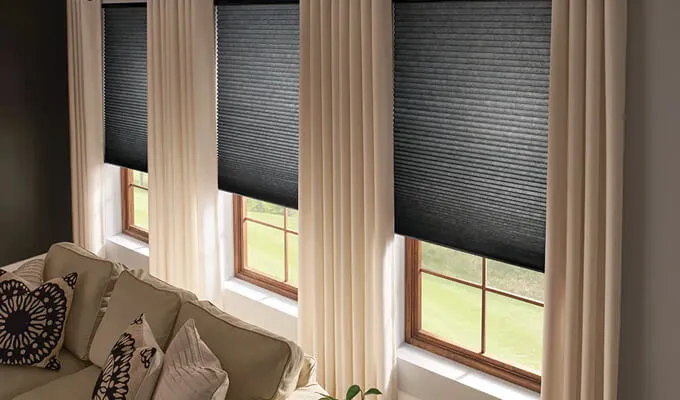
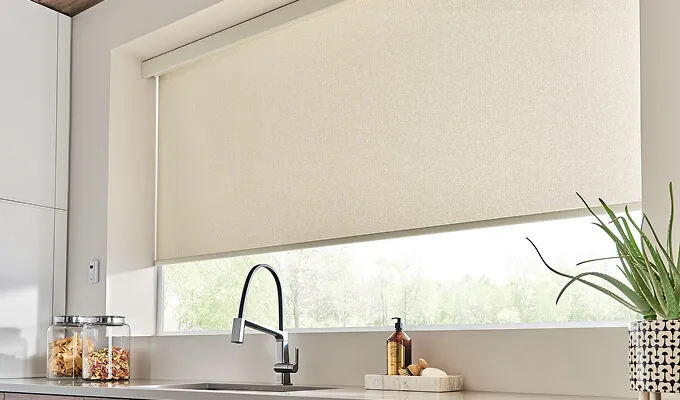
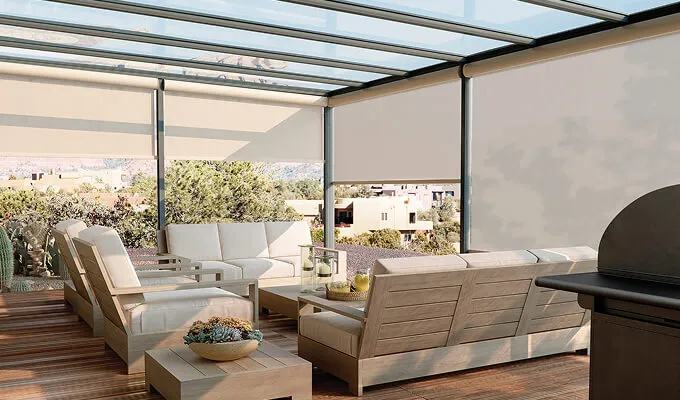
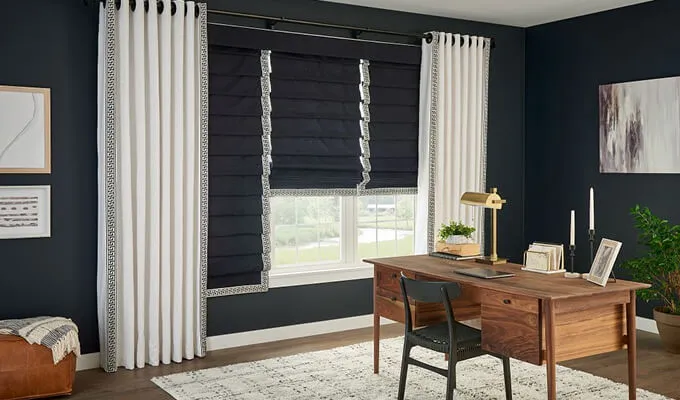
Walk into almost any new construction listing in Palm Beach right now and you’ll see it: a wall of glass instead of a wall of drywall, blurring the line between the living room and the pool deck, or the primary suite and the water view it was built to showcase. It photographs beautifully. It’s a genuine selling point. And it’s also something a lot of homeowners discover, usually within the first few months of actually living with it, comes with a set of tradeoffs nobody mentioned during the walkthrough.
This isn’t an argument against window walls — they’re a legitimately striking architectural feature, and there’s a reason builders keep leaning into them. But if you own one, or you’re about to, it’s worth understanding the real, lived-in experience of a home built around that much glass, rather than just the version you saw in the listing photos.
The Privacy Problem Nobody Warns You About
A window wall doesn’t just let light in during the day — it puts you on display at night. Once the sun goes down and interior lights come on, floor-to-ceiling glass turns your living room into something closer to a lit storefront window from the outside. This is especially true for homes on smaller lots or near walking paths, where the distance between your window wall and a passerby’s sightline is a lot shorter than it looked on the architectural rendering.
Most homeowners don’t fully register this until the first evening they’re sitting in their new living room with the lights on, and it suddenly occurs to them that anyone outside can see exactly what they’re doing, wearing, and eating for dinner. It’s not usually a dealbreaker, but it’s a genuine adjustment — and one that traditional window coverings sized for a normal window opening simply weren’t built to solve.
Glare That a Regular Living Room Never Has to Deal With
A standard window lets in light from one direction, for part of the day, at a scale a normal shade or curtain was designed to manage. A window wall multiplies that light exposure dramatically — not just because there’s more glass, but because floor-to-ceiling glass captures light at angles a shorter window never would, including low, direct sun near sunrise and sunset that a smaller window would simply miss.
The result, for a lot of Palm Beach homeowners, is a living space that’s genuinely difficult to sit in during certain hours — not because the room is poorly designed, but because nothing was ever put in place to manage the sheer volume of light coming through it. TVs become unwatchable in the afternoon. Reading in a favorite chair means squinting or repositioning furniture around the sun’s schedule instead of your own comfort.
The AC Bill Surprise
Glass is a far worse insulator than a wall, full stop. A window wall means a huge percentage of one side of your home is essentially a giant heat-transfer surface, especially in a climate where the AC is running most of the year. Homeowners who move from a traditionally windowed home into one with a floor-to-ceiling glass wall are often caught off guard by how much harder — and more expensive — it becomes to keep that room at a comfortable temperature, particularly in rooms that face west or get direct afternoon sun.
It’s rarely framed this way during the design or buying process, since the focus is understandably on the view and the aesthetic. But living with the ongoing cost of cooling a room with that much glass is a very real, very recurring part of owning one of these homes.
Why Standard Solutions Don’t Really Work Here
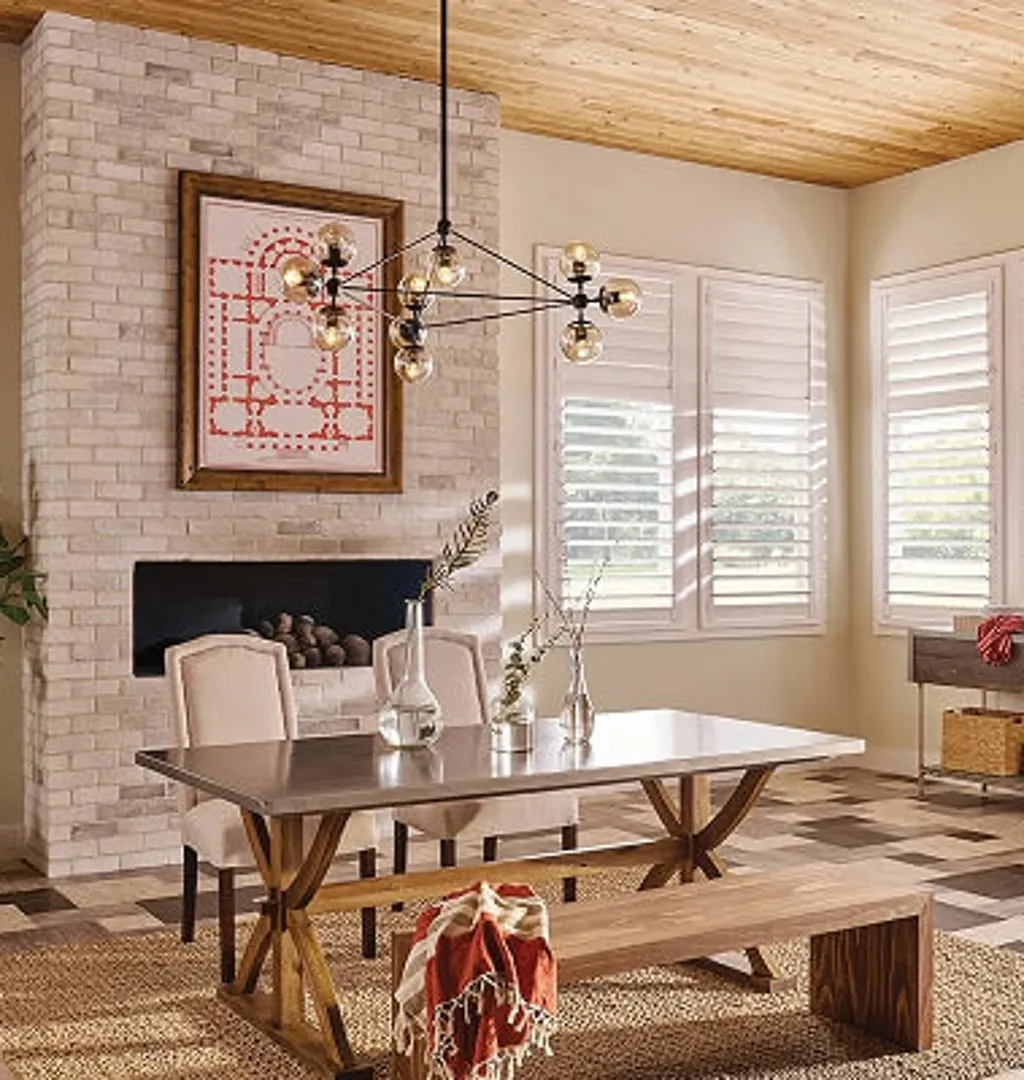
The instinct a lot of homeowners have is to solve a window wall the same way they’d solve a regular window — hang some curtains, maybe add a shade. The problem is scale. A treatment sized and engineered for an 8-foot window doesn’t necessarily perform the same way stretched across 20 or 30 feet of continuous glass. Fabric can sag differently at that scale, tracks and hardware need to support significantly more weight and span, and a light-filtering fabric that felt appropriately sheer on a small window can let through an overwhelming amount of light once it’s covering that much surface area.
This is a case where “just get a bigger version of a normal shade” genuinely doesn’t translate, and homeowners who try that route often end up frustrated with a treatment that doesn’t operate smoothly, doesn’t fully solve the glare or privacy problem, or looks visually out of proportion with the scale of the window itself.
What Actually Works for a Window Wall
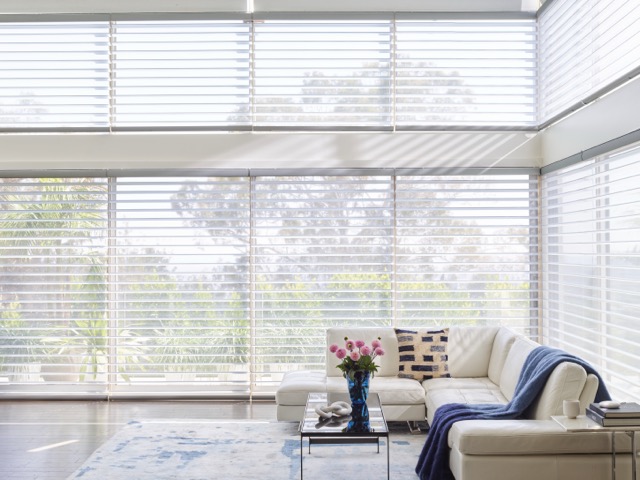
Motorized shades built for large-span openings. Motorization becomes less of a luxury and more of a practical necessity once a shade spans a wall-sized window — manually operating a shade that size, especially if it needs to be adjusted multiple times a day as the sun moves, is genuinely impractical. A motorized system designed for the scale of the opening solves both the physical difficulty of operation and gives you scheduling control over glare throughout the day.
Zoned or multi-panel shade systems. Rather than one continuous shade trying to do everything, window walls often perform better with shades broken into zones — allowing you to close off the section catching direct afternoon sun while leaving the rest of the wall open, instead of an all-or-nothing approach across the entire span.
Light-filtering fabrics chosen specifically for scale. A fabric’s opacity behaves differently across a large continuous span than it does on a small window, so fabric selection for a window wall benefits from being evaluated in the context of the actual room and light conditions, not just a swatch sample.
A privacy plan for evening hours specifically. Since the daytime and nighttime challenges of a window wall are genuinely different problems — glare and heat during the day, visibility at night — some homeowners benefit from a layered approach that handles both rather than a single fabric trying to solve two very different issues.
It’s Not About Regretting the Window Wall
None of this is an argument that window walls are a mistake. For a lot of Palm Beach homes, especially those built around a water view or a resort-style pool area, they’re genuinely one of the best architectural decisions a builder could make. The issue isn’t the window wall itself — it’s that most homeowners aren’t warned about the practical reality of living with one, and end up solving the privacy, glare, and heat problems reactively instead of planning for them from the start.
Frequently Asked Questions
Why does a window wall let in so much more heat than a regular window of similar total square footage?
It’s less about total square footage and more about angle and continuity. A single large, unbroken pane captures direct sun across its entire surface at once, including low-angle morning and evening light that a smaller, more traditional window arrangement would partially block through wall space and framing.
Can motorized shades really handle a wall-sized window without sagging or malfunctioning over time?
Yes, when the system is designed and engineered specifically for that span. This is exactly why off-the-shelf or standard-sized shade hardware often fails on a window wall — the mounting, motor strength, and fabric tensioning all need to be specified for the actual size of the opening, not adapted from a smaller product.
Is it possible to keep some transparency during the day and still get privacy at night?
Yes. This is one of the more common goals homeowners have for a window wall, and it’s usually solved with a layered or dual-shade approach — a sheer, light-filtering option for daytime glare control, paired with a more opaque option for evening privacy, rather than relying on a single fabric to do both jobs.
Do window walls always need to be covered across their entire span, or can sections be left uncovered?
Zoned or multi-panel systems make it possible to cover only the portion of the window that’s actually causing a problem — for example, just the section catching direct afternoon sun — while leaving the rest of the window wall open and unobstructed.
How do I know if my window wall needs a custom solution versus a standard shade?
As a general rule, any continuous span significantly larger than a standard window opening benefits from an in-person assessment rather than a generic product. An in-home consultation can confirm whether your specific window wall needs custom engineering or whether a more standard product will actually perform well.
Let’s Talk About Your Window Wall
If you’re living with a window wall that looks incredible in photos but has become genuinely difficult to actually live with — too bright, too exposed, or too expensive to keep cool — you’re dealing with a problem that has real, engineered solutions, not just workarounds. Bumble Bee Blinds of Palm Beach specializes in exactly this kind of large-scale, non-standard window treatment project.
Ready to make your window wall as livable as it is beautiful? Schedule a free in-home consultation with Bumble Bee Blinds of Palm Beach.